 |
|
The Inner Voyage The Ascension Career Unit 2 Dreams
Instructions to Students & Teachers -: In this first lesson we are 5th Epochal Revelation Quotes - The entire ascendant plan of Lesson Content - We’ve probably all wondered
Dreams The flip side of your conscious life It is through dreaming the human mind retains it's sanity.
Your brain the amazing machine mind map How to locate and develop your soul
The technique How to get the most out of your exercise Examples of success Points to remember Feedback sheet
Terms used in Lesson Presentation: PSI ~ Term used for the mid-mind or the human soul
Divine Sistership Urantia Book Quotes Divine Sonship
"The advances of true civilization are all born in this inner world of mankind. It is only the inner life that is truly creative. Civilization can hardly progress when the majority of the youth of any generation devote their interests and energies to the materialistic pursuits of the sensory or outer world.
The inner and the outer worlds have a different set of values. Any civilization is in jeopardy when three quarters of its youth enter materialistic professions and devote themselves to the pursuit of the sensory activities of the outer world. Civilization is in danger when youth neglect to interest themselves in ethics, sociology, eugenics, philosophy, the fine arts, religion, and cosmology."
Jacob's Ladder Unit 2 Dream Power
Do you dream? Does everyone? Can dreams be of any practical value? The answer to all of these questions is - YES. Consider these examples:
A writer for an advertising agency goes to bed with a pen, note book and flashlight beside his bed. AT 4:00 a.m. he wakes up and writes down his dream. In the morning he reads it, and takes it to his office. A few weeks later it is being viewed as a television commercial for a famous lingerie company. A university students struggles with a complicated mathematics question. Finally he gives up and goes to bed. In the morning he remembers a dream in which he solved the equation. He writes it down and takes it to class. Sure enough, it is the correct answer.
These people not only know that they dream, but they are making dreams pay off for them. So can you. This Lesson will teach you how.
In the first lesson you learned how to start your voyage inward by applying the lesson one exercise regularly. If you've done your lesson one exercise well, dreams should be starting to come up to the surface of your mind - now you'll learn how to put them to use.
WHAT ARE THE BENEFITS FROM UNDERSTANDING
YOUR DREAMS?
Dreams will allow you to discover submerged parts of your personality parts that influence your waking life, even though you are unaware of them. You can relive significant childhood experiences. You can learn to analyze your own dream symbols. And dreams will increase your creative potential. It is the easiest way to tune into your intuitive self, allowing you to receive insights and inspiration beyond your normal thought patterns.
You can become aware of the events before they occur. This is because, besides the physical body with its limbs, organs and physical brain to register the impressions from the 5 senses, there is the subtle inner self of infinite potential. The "PSI" (term used for the mid mind or human soul) when free, is able to think independently of the physical self, especially during sleep. In fact, the sleep state is one of the best times to distinguish between our 2 (two?) often contrasting identities Studies show that 70% of extra-sensory perception takes place in dreams.
Most of life is studied by the sense of sight and our varying interpretations of these visual images. The indwelling spirit often attempts to use a pictographic format to communicate before the actual voice of your indwelling spirit can be heard. The world of dreams is a truly fascinating one.
DREAMS: A TIME-TESTED TOOL
Although research and interest in dreaming is relatively recent in modern times, ancient man was fully aware of the importance of dreams in helping to solve problems. There are countless references to dreams in literature, including the Bible, the Koran and in the writings of the ancient poets, historians, scientists and philosophers.
DREAMING IS COMMON TO ALL RACES, NATIONALITIES and TIMES.
There are dream books in English, Dutch, Arabic, French, German, Greek, Russian, Siamese, Latin and in many other languages.
Belief in the significance of dreams is nearly as old as dreams themselves. MANY of our modern inventions and ideas are a direct result of dream content.
The dignity of the interpretation of dreams has been alive throughout the ages. Professional interpreters of dreams existed among the ancient Babylonians, Assyrians, Arabs and Egyptian. Atlantean metaphysicians recognized the importance of dreams and the duality of man's nature long before Freud re-discovered the Psyche.
Perhaps the best known example from the Old Testament is the story of Joseph's interpretation of the Pharaoh's dream about 7 fat cows and 7 lean cows. It foretold of 7 years of famine which would strike Egypt after enjoying 7 years of plenty.
Other ancient civilizations that believed firmly in the importance of dreams were the Incas and the North American Indians.
Then there is the provocative example of the 12 000 member Senoi tribe living in the jungles of Malaysia, who claim an absence of violent crime, or mental illness in their society. Anthropologists and psychologists who have spent considerable time directly observing the Senoi have reported that these are people of extraordinary psychological adjustment. Neuroses and psychoses as we know them are reported to be non-existent among the Senoi, who show remarkable emotional maturity.
DREAMS PLAY A MAJOR ROLE in the cultural life pattern of the Senoi. 1. At breakfast, each member of the family relates their dreams of the previous night. 2. No one will say "I don't know" or "I don't remember"; for dreams are the most central aspect of Senoi life, and everyone does remember. 3. Children begin to report their dreams as soon as they can talk. Each dream is discussed with all the members of the family who aid in the interpretation of the content and give suggestions on how to change behavior and attitudes in future dreams.
BRAIN WAVES
Recently science has brought forth many facts about the functions of sleeping. Shortly after World War I, Dr. Hans Berger discovered the "Alpha Wave" and many other dedicated men and women have carried on from there. The 10 to 12 billion cells in our brain, many of which are capable of storing 1 - 2 million pieces of information, are like minute electrical generators, each giving off energy. Each cell within the entire body (One Quadrillion Cells) has a volt potential of 1.17 Volts. To find out what is going on in the brain during sleep, little electrodes are placed on the scalp and the brain waves recorded on an electroencephalograph (E.E.G.). Dr. Berger first measured the wavelengths of subjects who were sleeping, so Alpha was the first cycle to be named.
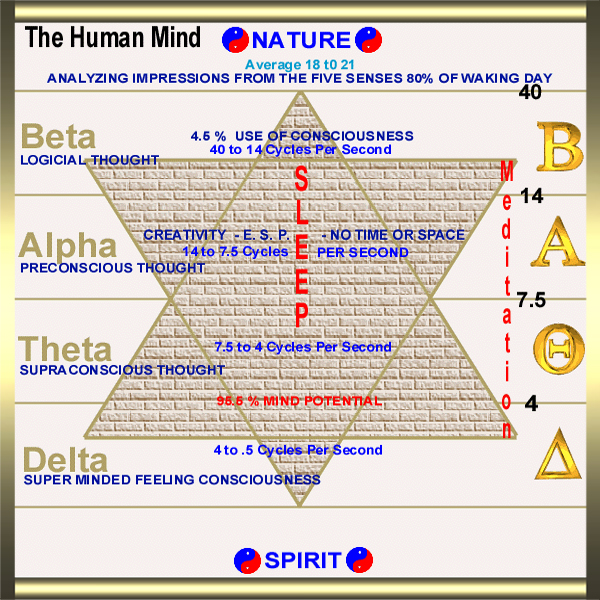
As you can see on your Chart #2; The Human Mind, 4 different kinds of wavelengths were discovered.
1. The BETA Range:
Beta runs from 14 to 40 cycles per second. This range of thoughts makes us very aware of time and space. It is the level of logical - analytical thought. It includes thought levels of mental activity - such as filling out your income tax form, or doing any physical activity. It often results in the symptoms such as anxiety, tension and anger.
2. The ALPHA State:
Between 7.5 to 14 cycles per second - seems to be the result of a synchronized, more rhythmic activity - a quieting down of the whole system into a pulsating hum. It is associated with such states of mind as creativity, dreaming, tranquility, inspiration, accelerated healing, memory and learning on a conceptual level. There is an absence of time-space details. Just like when you used to day-dream in your history class.
3. The THETA Scale:
From 4 - 7.5 cycles per second is a further slowing down or unwinding of brain activity, reflecting an ever-deepening state of consciousness and potentially even greater levels of learning and accelerated healing. This scale is reached in a deeper state of sleep.
This dream permitted the young man to satisfy these two warring factions within himself - but of course the relief was temporary.
There is another aspect to Freudian kinds of dreams. During the day we are bombarded by incoming information from our 5 senses. Some of these pieces come in the neatly shaped square, rectangular or circular patterns that fit our preconceived ideas. These can readily be accepted and filed away. But it is as if the odd shaped pieced that don't fit properly go into a basket labelled - "For attention later." Sometimes that basket is overflowing by the time we go to sleep. Night time is when all of these new ideas can be re-shaped and manipulated, so they can be assimilated into our general logic structure.
Many of the pieces represent reaction to stress. The boss didn't smile this morning, another bill comes in the mail - there is something the matter with the car - feelings of anxiety and threat reaction follow.
Perhaps that night we would dream that the boss slops on a banana peel as we leave for a vacation driving a brand new car. EGO will have to whip up dreams to diminish our frustrations until we feel back on top of things again.
II. Retrogressive Dreams
It is obvious that if we want to spend less time rationalizing in Freudian dreams, we must rise above petty frustrations. In retrogressive dreams, we can actually relive events from our past. It's sometimes like watching an old home movie.
Remember the student who could not drink milk. After doing his #1 Lesson technique one night - he had a dream. He dreamt he was 3 years old nursing at his mother's breast. He felt her warmth and softness that nurtured him. Then he experienced the emotion of feeling cut off - his mother began to feed him with a bottle - and he longed to return to the softness and warmth of breast feeding.
We've explained how our brain records and stores events much like a computer does. These memories are linked together according to the special pattern of "emotional logic" - which means that events that have a similar emotional meaning are joined together.
In the example just given the particular memory link went something like this:
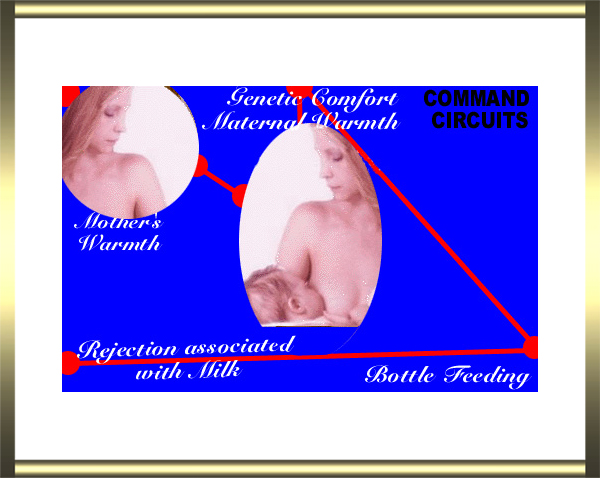
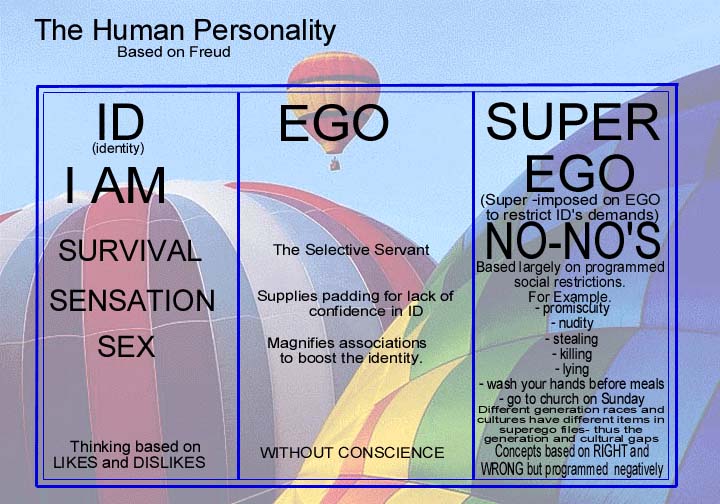
The daisy plant analogy represents our memories as they have been formed since the earliest infancy, even from the prenatal period. The petals are those events, feelings, etc... we can consciously recall which are linked below the conscious level to more, even earlier memories now deeply hidden from conscious recall. When we dream, these deeply buried events will surface in symbols at first. Strong emotions are associated with these early events and it is through digging and recall that we release these emotions. Instant cures of asthma, allergies, phobias, etc... frequently occur as a result of self-realization. Early memories carry strong feelings of dislike or like association, or perhaps neutral ones. By recognizing our own likes and dislikes, we gain a clearer picture of our identity and how Ego will find ways to satisfy ID. Have you ever had a dream of your childhood? If you have, write it down
III. Psychic Dreams
The 3rd type of dream, the "psychic" dream is our eventual goal. Under normal circumstances, 70% of psychic experiences occurs in the dream state. Freed of the weight of unresolved conflicts or the pull of unfulfilled desires, the identity is able to benefit by special knowledge derived from the 6th sense.
Psychic dreams include a variety of activities such as:
Telepathic communication has been demonstrated in dream labs. One person (a sender) would concentrate on a picture picked at random after the subject (the receiver) went to sleep. The subject upon being awakened from REM sleep would describe a dream involving elements of the picture, sometimes to an astonishing degree of accuracy.
Your textbook Dream Power Through Dream Analysis" has many examples of the varieties of psychic dreams. The following are some classic examples of problem solving and inspirational dreams. Louis Agassiz, the naturalist, once attempted to transfer the image of a fossil fish from a stone but found the image blurred. A few nights after he abandoned the project, he had a dream in which he saw the entire fossilized fish. The following morning, he hurried to his laboratory - but found the vague image unchanged. Hoping he might have the dream a third time, Agassiz placed pencil and paper by his bedside. When the dream returned, he took the paper and drew his image upon it with the pencil. On the following morning, he was surprised at the details he had produced in total darkness. Returning to his laboratory, he used the drawing as a guide and slowly began to chisel the slab. As a layer of stone fell loose he found the fossil in excellent condition - the identical fossil which had occurred in his dream.
Elias Howe had been frustrated in his early attempts to perfect the sewing machine; for years, everything he tried had failed. One night, he dreamed he had been captured by savages who dragged him before their king. The king issued a royal ultimatum: if within 24 hours Howe had not produced a machine that would sew, he would die by the spear. Howe failed to meet the deadline and saw the savages approaching; he saw the spears slowly rise, then start to descend.
Suddenly, Howe forgot his fear as he noticed that the spears all had eye-shaped holes in their tips. Howe awakened, realizing that, for his sewing machine, the eye of the needle should be near the point, not at the top or in the middle. Rushing to his laboratory, he filed a needle to the proper size, drilled a hole near its tip, and inserted it into the machine. It worked well and the problem was solved.
While in the army, Rene Descartes spent a winter of inactive duty in a hotel room. Discontent with army life, ideas spun through his brain in a disconnected, contradictory fashion. One night he had a dream in which all his previous thoughts fell into harmony. That illumination was the beginning of the philosophical and mathematical formulations that were to change the course of Western thought. Such philosophers as Al-Mamum and Synesius and the mathematicians Condorcet and Garden acknowledged their dependence on dream recall for some of their insights. Garden claimed that one of his books on mathematics was virtually composed in his dreams.
Then there is the example of Kekule's discovery of the carbon ring during his sleep. He was dozing off while working at a study of organic compounds, and in his dream atoms at first chaotically tumbled before his eyes, then took shape and moved like a snake. Finally the snake, consisting of groups of atoms, bit its own tail. Kehule awoke with the discovery of the carbon ring.
These are all examples of famous people - but anyone who is open can have creative of inspirational dreams.
How is your dream life? Do you think you have ever had a psychic dream? Did you ever wake up in the morning with the solution to a problem? If you haven't don't feel discouraged. You are on your way.
Dream analysis
The person who can utilize dream time constructively is living a fuller, more creative life. As we have seen, many creative geniuses have used dreams to gain insight into their work, which has benefited all of mankind. These kinds of people are operating on deeper levels of the mind; more than the 4 1/2% on which many rely. See The Human Mind Chart. You can too.
Lesson Technique
This is the meat of this lesson "Action"
The technique is not difficult or hard to understand. If you already remember your dreams you are off to a very good start. If you were one of the people who didn't think you ever dreamed, be encouraged. Many students before you thought likewise and considered themselves handicapped in this exercise - only to find that with practice, desire and perseverance they could remember their dreams. Here is how to go about it.
To remember dreams, each night as you go to sleep, tell yourself firmly that you will remember your dreams.
Dreams fly on awakening, so keep a pen and notebook right beside your bed.
3.Wake up slowly. Cast your thoughts inward instead of projecting them outward towards the external world.
4.Jot your dreams down as soon as you wake up. Some students keep their pen and notebook under their pillow, and write their dreams before getting out of bed.
5.Don't try to make sense out of your dreams. Just write them down.
6.Note everything. Everything. Even a tiny fragment is worth writing down. Also note the emotions you experienced in the dream.
7.Don't give up. The average mind is slow to accept new commands. At first it might think "Ha, ha! A new demand! He-she'll soon get over that nonsense if I ignore it." Then: "Boy, this is getting rough! Now I can't even get time off during the night! We subconscious should join a union "Then, "Oh well, if you insist.
8.Keep a dream diary. Tag every dream carefully in terms of date, time, place.
9. Try to classify each dream immediately after recording it as FREUDIAN, RETROGRESSIVE or PSYCHIC: F.R. or P. of a precognitive nature, get it took place on that date. They just get them to sign at the be able to verify a psychic at a later date.
10. If you believe a dream to be someone else to certify that don't have to read the dream bottom. The point here is to dream if the event comes true.
11. Don't try and analyze a single dream. Wait until you have 10 or more. It's only then that a pattern will begin to emerge. Also, you can be more objective about an old dream than with last night's episode. However, as you become more experienced, this time lapse will not be so important.
12. a Continue to do your self-knowledge exercise you learned in Lesson one. This stimulates retrogressive dreams. Re-read your writings. Any traces of inaccuracies, embellishments, self-pity, procrastination or ego's favorite tricks? Try to examine yourself with total objectivity. Assess your programming:.
· Likes · Dislikes · Command circuits · Strengths · weaknesses
You will gain more and more insight into the environmental influences which still direct your adult thinking.
13. Keep an open mind. Remember, scientists tell us that we use only about 4 1/2% of our mental potential in the waking state. Dreams are one of the doors to the other 95 1/2 %. By putting dream power to work, anyone, however sophisticated, however caught up they may be in the clamor of the sense world can take the inner voyage and discover for themselves THE GREAT REALITY, the Source of Power.
Your own mystery play is already happening every night. This lesson is your ticket to a front row seat. Start making dream power work for you tonight so that you, like many others can become a practical dreamer.
You are a Child of the Universe a Son or Daughter of the Living GOD
In our next lesson we will learn to place ourselves in a state between sleep and wakefulness, in order to take positive action on the information discovered through our dreams and through our Lesson One exercise - we will be learning the PAM technique of Meditation.
POINTS TO REMEMBER 1.Before you go to bed each night tell yourself, "I will remember my dreams,"
2.Write every dream or fragment, plus the emotion that went with it, in your dream diary. 3.Record about 10 dreams before you begin to analyze your dreams. 4.Continue doing your lesson # One writing exercise every day for at least twenty minutes.
A Fun Exercise
It is suggested that you try this exercise in 2 or 3 day's time. It can help you understand your dreams and yourself better. In the book Dream Power Through Dream Analysis read from the 2nd last paragraph on page 43 to page 50. Study the Basic Psychological Needs of Man" chart. Then make up a chart of your own. The basic needs will stay the same:
·Affection ·Creative Expression ·Meaning
But put in your sources of the concepts, examples of your details. One student reported an immediate improvement in her relationship with her husband after doing this exercise. Her affection details on her chart would have looked something like this:
Interestingly enough, her husband had a very different set of affection details, for the most part. Because of his programming he expressed his affection through fixing things in the house, building a family recreation room, and keeping the grounds of their home meticulously cared for. It rarely occurred to him to give her flowers - instead he would weed the flower bed, or shovel snow from the walk!.
Once she saw it was simply a case of their details not matching and that it did not mean that his love for her had diminished as she secretly feared (during their engagement flowers, dinners out and little gifts had from time to time been given), she experienced a whole new appreciation of her husband and understanding of herself. When you do the exercise, be sure to give details for family, friends and pets too. This example of "mate" was used to illustrate a point. The other sources are important too.
Another student, a successful artist, was shocked to find that the detail of art and his studio etc. showed up in every category. He saw that he was fulfilling his affection, creative expression, and meaning needs, all from the same detail. He decided to broaden his world and become more balanced person. Incidentally, not only did his family welcome this change of attitude but his work became even more successful. Have fun doing your own chart. Read and re-read the section in your textbook until you understand it enough to begin - then get ready for your own discoveries!.
FEEDBACK SHEET UNIT 2: DREAM POWER
1. Can you think of a few examples of an activity in which your mind will be in the beta range then in the alpha state? 2. Can you identify two of your command circuits? 3. Dream Symbology : Can you give a personal example of a symbol that you could have or have had while dreaming? 4. Have you ever had a retrogressive dream? If yes, write it down 5. Have you ever had a psychic dream? 6. Do you have any questions about dreams? 7. What have you learned be filling in your " Psychological Needs of man chart"
SUPPLEMENTARY READING Unit 2: Dream stories
From prehistoric time people of all conditions have dreamed. There are countless references to dreams in literature, including the Bible, and in the writings of the ancient poets, historians, scientists and philosophers. Dreaming is common to all races, nationalities, times and conditions. There are dream books in English, Dutch, Arabic, French, German, Greek, Russian, Siamese, Latin and many other languages. Belief in the significance of dreams is nearly as old as dreams them-selves. Many of our modern inventions and ideas are a direct result of dream content.
The dignity of the interpretation of dreams has been alive throughout long ages. There were professional interpreters of dreams among the ancient Babylonians, Assyrians, Arabs and Egyptians.
We will now look at random samples of famous dreamers of dreams: those that have left their mark on the progress of mankind. You may sit back and enjoy these stories in the anticipation of the unraveling of your own dream content.
A number of composers reportedly were inspired by melodies heard during the REM state. Tartini heard in a dream a sonata from which he drew inspiration for his famous "Devil's Trill." Mozart, Schumann, Saint-Saens, and d'Indy claimed that some of their music was first heard by them in dreams.
A number of instances exist in which dreams have served a problem-solving function. When he was a student, the physicist Niels Bohr had a vivid dream. He saw himself on a sun consisting of burning gas while planets seemed to whistle as they passed by. The planets appeared to be attached to the sun by thin filaments and revolved around it. Suddenly the burning gas cooled and solidified; the sun and planets crumbled away. Bohr awakened realizing he had conceptualized the model of an atom, the sun being the fixed centre around which electrons revolved. Much of the basic theory upon which atomic physics is based came out of this dream.
Otto Loewi, a pharmacologist, won a Nobel Prize for the discovery that control of the heartbeat is not through direct nerve influence. When he accepted the Nobel Prize in 1936, he said, 'The story of this discovery shows that an idea may sleep for decades in the unconscious mind and then suddenly return to the consciousness." Loewi had first disagreed with the prevailing theory in 1903, but it was not until 1920 that his ruminations on the problem congealed in the dream state. In fact, he wrote this dream on paper and went back to sleep. The following morning, Loewi looked at his writing and was unable to decipher it. That night he had an identical dream, awakened, and went directly to his laboratory. He prepared two frogs for an experiment which demonstrated that nerves affect heart function through a mediating chemical rather than through a direct connection.
Mother inventor, James Watt, had been working on lead shot for guns. The standard process involved cutting or chopping metal and was quite costly. About this time, Watt had a recurring dream. He seemed to be walking through a heavy storm; instead of rain, he was showered with tiny lead pellets. Awakening, he surmised that the dream might indicate that molten lead, falling through the air, would harden into small spheres. Obtaining permission to experiment in a church which had a water-filled moat at its base, Watt melted several pounds of lead and flung it from the bell tower.
Hastening down the stairs, he scooped from the bottom of the moat the tiny leaden pellets - inaugurating a process that revolutionized the lead shot industry.
Goethe, who was about 22 years of age had just said farewell to Fredericka Brion, with whom he was in love, at Sesenheim in Alsace: "I now rode on horseback over the footpath to Drusenheim, when one of the strangest experiences befell me. Not with the eyes of the body, but with some gold. As the spirit, I saw myself on horseback coming toward me on the same path dressed in a suit such as I had never worn, pale-gray with some gold. As soon as I had shaken myself out of this reverie the form vanished. It is strange, however, that I found myself returning on the same path eight years afterward to visit Fredericka once more and that I then wore the suit I had dreamed of, and this not by design but by chance. Be this as it may, the strange phantasm had a calming influence on my feelings in those moments following the parting."
Plato in his Phaedo tells us how Socrates had a recurring dream in which he was commanded to make and cultivate music. Socrates, says Plato, took it as an exhortation to study philosophy, which he had always regarded as the noblest and best of music.
One of the earliest examples of a dream of this type recorded in English literature is that of Caedmon, told by Bede (673-735) in his Historia Bcclesiastica. This famous work was translated into English at the end of the ninth century by scholars who worked under the direction of King Alfred.
Caedmon was a cowherd who, Bede, tells us, "had lived a secular life up to the time that he was getting on in years and had never learned a song. Now often at the feast it was decreed for the sake of rejoicing that each in turn should sing to the harp." When he saw the harp coming near him, he arose in shame from the feast and went home. On one occasion he did this and left the house of the feast and had gone out to the cattle shed, of which he had been put in charge that night. When he had duly laid his limbs to rest there and fallen asleep, someone stood before him in a dream and hailed him and called him by his name: "Caedmon, sing me something." Then he answered and said: "I cannot sing; and so I left the feast and came hither, because I could not sing." He who had spoken to him again said: "However that may be, thou canst sing to me." Then he said: "That shall I sing?" He replied: "Sing me the beginning of creation."
When he received that answer, he at once began to sing in praise of God the Creator verses and words which he had never heard before.
We are told that after he awakened Caedmon clearly remembered all that he had dreamed. He became a monk at Whitby Abbey, where he spent the rest of his life, lie achieved great distinction with his newly-discovered gift of song, and was held in great repute by his brother-monks, none of whom was able to equal his poetic genius. He devoted his remaining years to composing poems of religion and piety, none of which unfortunately has survived. We learn, however, that their power was such as to inspire many to follow his example and take monastic vows, as well as to initiate a tradition of Anglo-Saxon religious poetry, which was, however, put an end to by the Danish invasions.
The Coronation Dream
A singular case of an apparently recurrent dream was reported at the time of the Coronation of King Edward VII of England, in l9O2 Early in June, the ceremony was set for the 26th of the month and the Duke of Portland, who held the high official rank of Master of the Horse, took charge of arrangements for the coronation procession.
Though that involved many details, the basic pattern was simple enough as the procession was to follow the traditional route, which was last used by Queen Victoria, some sixty-four years before. The Duke of Portland checked that out, found it quite satisfactory and then devoted his attention to other details, all of a more modern and more pressing nature. That was when he had his dream.
In his dream the duke saw the crown that topped the royal coach topple from its perch. He was so impressed by the dream that he inspected the old royal coach and found the crown firmly fixed. He examined the wheels and all the rest, to find everything in order. Nothing, it seemed, could possibly trouble the royal coach along that route.
So when the duke had another similar dream, he began to see a symbolism in it. The king himself might be endangered, perhaps the monarchy as well. Then suddenly, the king became seriously ill, confirming that impression. With only two days to go, the Coronation was postponed, not to the duke's relief, but to his fear that it might never be held, as the dream could have presaged the king's death.
Instead, King Edward recovered rapidly and the coronation was set for August 9th, which pleased everybody except the Duke of Portland, because he had the same dream again, more vividly than before. The crown toppling from the top of the coach could mean that the king could suffer a relapse and there would never be a coronation of Edward VII, King of England.
Picture the duke's dilemma. Should he talk to the king and warn him of the premonition? That would be bad, in fact very bad. The king's physicians had decided that he would be well enough to go through with the Coronation, but even they were pressing it as something immediate, which brooked no interference. Even to suggest some problem might provoke the very relapse that the duke feared.
So the Duke of Portland concentrated on the matter of the coach itself, perhaps on the assumption that he personally might be more deeply involved that the king. If the dream concerned the royal coach, that could produce problems for the duke himself, as Master of the Horse. So the proper thing was to make another check of the route that the coach was to follow.
The duke did exactly that and came to the Horse Guard's Arch, under which the royal coach had always passed with room to spare. But when he had it measured , just to make sure, it proved to be a foot or more too short. Which meant that: If the coronation procession had taken place as planned, the crown that topped the royal, coach would have crashed into the archway and would have toppled down, just as in the dream!
But why?
The royal coach had gone through that same archway, time and time again, without any problem. But "time again" was in itself a misnomer. Times between coronations had been shorter, a century and more ago. People had lived more slowly, with fewer changes and fewer cares, back in those days. Modern improvements, such as better paving, had not even been considered, even as late as the time of Queen Victoria' Coronation, which after all, had been held sixty-four years ago.
So the Duke of Portland found the answer to his problem, through a dream. During those sixty-four years, the London streets had been re-paved with increasing frequency the Horse Guard's Arch had worked upward without anyone realizing it, until the archway itself was too low to accommodate the royal coach
That was properly rectified. There wasn't time to lower the roadway or raise the arch. But it was simple to alter the royal coach by bringing the crown down just enough so that it could pass through, coach and all, with no problem. So that done and the Coronation of Edward VII went through as scheduled, thanks to the heeding of a warning from a dream.
A Student's Dream
I found myself in a jungle, swinging back and forth from a spider-web-like rope, much like a pendulum of a clock. I was terrified since each time I swung back and forth the spider web grew thinner and stretched down further. Beneath me was a huge flower bud, and coiled around the bud was a huge snake. I was afraid the rope would break and I would fall into the snake. Suddenly my worst fears came true. The rope broke and I fell towards the snake. Just as the snake was going to get me , the flower sprang open and blossomed. I landed right in the center of the flower on a soft, velvety cushion. As I looked around at the petals, I saw that they were all the different colors of the rainbow.
The snake represented my ego, trying to keep secrets from me, so I would not take the inward voyage and discover my real self. The flower showed how much I had to gain and how there was nothing at all to fear in taking this voyage. The rope rep-resented my own state of mind - swinging one way and then another.
A Student's Dream
I had been doing the taught techniques for some months yet seemed to be making little progress. One night I had a dream. I found myself on a narrow street with high brick walls on both sides. It appeared as if parts of the walls had been torn down and were now being replaced by workmen. This rather puzzled me as there appeared to be nothing wrong with old walls. I watched rather awed at how neatly the workmen were replacing the bricks.
I realized the brick walls were what I had been trying to tear down with my technique, but, because I had been putting no real emotional energy in this, the walls were immediately rebuilt. My progress was much faster after this dream.
U-Book Quotes
PLEASE USE YOUR BROWSERS BACK BUTTON TO RETURN TO THIS PAGE 110:5.3 During the slumber season the Adjuster attempts to achieve only that which the will of the indwelt personality has previously fully approved by the decisions and choosings which were made during times of fully wakeful consciousness, and which have thereby become lodged in the realms of the supermind, the liaison domain of human and divine interrelationship.
110:5.4 While their mortal hosts are asleep, the Adjusters try to register their creations in the higher levels of the material mind, and some of your grotesque dreams indicate their failure to make efficient contact. The absurdities of dream life not only testify to pressure of unexpressed emotions but also bear witness to the horrible distortion of the representations of the spiritual concepts presented by the Adjusters. Your own passions, urges, and other innate tendencies translate themselves into the picture and substitute their unexpressed desires for the divine messages which the indwellers are endeavoring to put into the psychic records during unconscious sleep.
110:5.5 It is extremely dangerous to postulate as to the Adjuster content of the dream life. The Adjusters do work during sleep, but your ordinary dream experiences are purely physiologic and psychologic phenomena. Likewise, it is hazardous to attempt the differentiation of the Adjusters' concept registry from the more or less continuous and conscious reception of the dictations of mortal conscience. These are problems which will have to be solved through individual discrimination and personal decision. But a human being would do better to err in rejecting an Adjuster's expression through believing it to be a purely human experience than to blunder into exalting a reaction of the mortal mind to the sphere of divine dignity. Remember, the influence of a Thought Adjuster is for the most part, though not wholly, a superconscious experience.
110:5.6 In varying degrees and increasingly as you ascend the psychic circles, sometimes directly, but more often indirectly, you do communicate with your Adjusters. But it is dangerous to entertain the idea that every new concept originating in the human mind is the dictation of the Adjuster. More often, in beings of your order, that which you accept as the Adjuster's voice is in reality the emanation of your own intellect. This is dangerous ground, and every human being must settle these problems for himself in accordance with his natural human wisdom and superhuman insight.
110:5.7 The Adjuster of the human being through whom this communication is being made enjoys such a wide scope of activity chiefly because of this human's almost complete indifference to any outward manifestations of the Adjuster's inner presence; it is indeed fortunate that he remains consciously quite unconcerned about the entire procedure. He holds one of the highly experienced Adjusters of his day and generation, and yet his passive reaction to, and inactive concern toward, the phenomena associated with the presence in his mind of this versatile Adjuster is pronounced by the guardian of destiny to be a rare and fortuitous reaction. And all this constitutes a favorable co-ordination of influences, favorable both to the Adjuster in the higher sphere of action and to the human partner from the standpoints of health, efficiency, and tranquillity.
True Psychic Dreams adding to spiritual insights. from the revelation.
153:3.6 The Pharisaic commissioners of the Jerusalem Sanhedrin were now almost convinced that Jesus must be apprehended on a charge of blasphemy or on one of flouting the sacred law of the Jews; wherefore their efforts to involve him in the discussion of, and possible attack upon, some of the traditions of the elders, or so-called oral laws of the nation. No matter how scarce water might be, these traditionally enslaved Jews would never fail to go through with the required ceremonial washing of the hands before every meal. It was their belief that "it is better to die than to transgress the commandments of the elders." The spies asked this question because it had been reported that Jesus had said, "Salvation is a matter of clean hearts rather than of clean hands." But such beliefs, when they once become a part of one's religion, are hard to get away from. Even many years after this day the Apostle Peter was still held in the bondage of fear to many of these traditions about things clean and unclean, only being finally delivered by experiencing an extraordinary and vivid dream. All of this can the better be understood when it is recalled that these Jews looked upon eating with unwashed hands in the same light as commerce with a harlot, and both were equally punishable by excommunication.
122:2.5
For five months, however, Elizabeth withheld her secret even
from her husband. Upon her disclosure of the story of Gabriel's
visit, Zacharias was very skeptical and for weeks doubted the
entire experience, only consenting halfheartedly to believe in
Gabriel's visit to his wife when he could no longer question
that she was expectant with child. Zacharias was very much
perplexed regarding the prospective motherhood of Elizabeth, but
he did not doubt the integrity of his wife, notwithstanding his
own advanced age.
It was not until about six weeks before John's birth that
Zacharias, as the result of an impressive dream, became fully
convinced that Elizabeth was to become the mother of a son of
destiny,
one who was to prepare the way for the coming of the Messiah.
122:4.1
Joseph did not become reconciled to the idea that Mary was to
become the mother of an extraordinary child until after he had
experienced a very impressive dream.
In this dream a brilliant celestial messenger appeared to him
and, among other things, said: "Joseph, I appear by command of
Him who now reigns on high, and I am directed to instruct you
concerning the son whom Mary shall bear, and who shall become a
great light in the world. In him will be life, and his life
shall become the light of mankind. He shall first come to his
own people, but they will hardly receive him; but to as many as
shall receive him to them will he reveal that they are the
children of God." After this experience Joseph never again
wholly doubted Mary's story of Gabriel's visit and of the
promise that the unborn child was to become a divine messenger
to the world.
It is for the reasons stated above that the teachers of this course do not attempt to analyze the dream's of the students of this course. The pictographic Symbology utilized by the spirit indweller is so unique to the individuals association with this valiant spiritual pilot throughout the mortal life struggle that only the individual soul can make personal progress in increasing capacity for communion with the spirit of GOD and this ability is directly related to the individuals willingness to actually know GOD in there personal religious experience. (PBK) Please use the e-mail link below if you have
questions about this lesson
You are a child of the
universe, no less than the trees and the stars, you have a
right to be here.
|






.png)